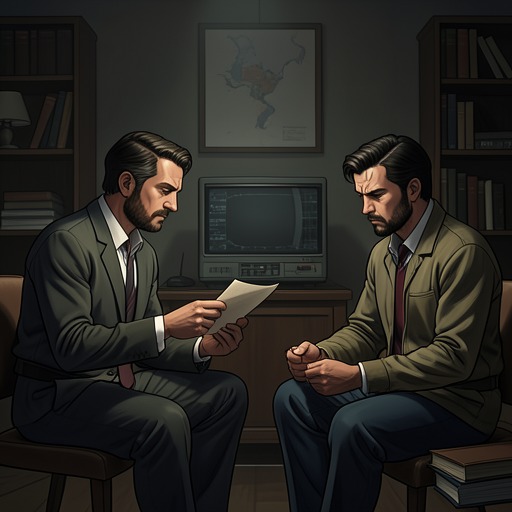
The relationship between Albert Wilmarth and Henry Akeley
The Colour Out of SpaceAlbert N. Wilmarth and Henry Wentworth Akeley begin as opponents in a public argument about the strange beings said to have appeared during the 1927 Vermont floods. They become private correspondents and collaborators, comparing folklore and physical evidence from the hills around Dark Mountain. The relationship’s decisive change is Wilmarth’s movement from explaining Akeley away to accepting his invitation and entering the isolated farmhouse where their exchange of knowledge becomes an immediate and unsettling encounter.
Public Dispute and First Contact
Wilmarth, an instructor of literature at Miskatonic University in Arkham and an amateur student of New England folklore, initially treats reports of strange bodies in flooded rivers as superstition magnified by old legends. He had never visited Vermont, but knew the traditions through Eli Davenport’s rare monograph and stories gathered in New Hampshire. His confidence in a folkloric explanation made him a prominent sceptical voice when the flood reports prompted debate.
The argument reached newspapers, including the Arkham Advertiser, and Vermont papers reprinted both sides. By spring 1928, Wilmarth had become a familiar figure in Vermont despite never having set foot in the state. Akeley’s challenging letters changed the terms of the dispute: unlike distant enthusiasts, Akeley lived near the hills and claimed direct contact with the phenomena. Wilmarth regarded him as educated, intelligent, and cautious enough to leave conclusions tentative. He did not accept Akeley’s claims at once, but considered them worthy of investigation rather than dismissing their author as insane.
Evidence and a Shared Inquiry
Akeley’s accounts connected the recent reports to older traditions of hidden beings in remote hills. The stories described claw-prints, caves, and buzzing voices that imitated human speech; some later legends also told of recluses suspected of becoming allies or representatives of the beings. Wilmarth had previously treated such material as a familiar pattern of folklore. Akeley’s proximity to the reported events, and his insistence on evidence, made the inherited stories harder for Wilmarth to set aside.
The correspondence turned that change of mind into a working partnership. Akeley sent a phonograph record made near a cave on the west slope of Dark Mountain at about one in the morning on May 1, 1915, a date he had chosen because he expected May-Eve to be unusually fruitful. The recording preserved fragments of a distant, quasi-ritualistic exchange: one voice seemed human and cultivated, while another spoke grammatical English in a buzzing tone Akeley considered inhuman. Its poor, muffled quality limited what it could establish, but the record gave their discussion a material object they could examine rather than a rumour they could merely debate.
Photographs added another kind of evidence. Among them was a claw-like impression in an upland mud patch, its scale indicated by sharply visible pebbles and grass. Wilmarth found the image difficult to explain as a trick and increasingly accepted that something outside ordinary knowledge was present in the Vermont hills. The images did not settle what the beings were, but they shifted the correspondence from abstract argument toward the comparison of traces, testimony, and legend.
Confidential Collaboration
After receiving Akeley’s first letter, Wilmarth replied in a tone of friendly interest and asked for further particulars. Akeley sent the photographs promptly, and the two continued writing through late May and June. They compared the Vermont accounts with wider mythological traditions and considered the possibility that the creatures belonged to the same order as the Himalayan beings known in legend as the Mi-Go. Akeley also urged secrecy, warning that publicity might bring curious people into places they should leave alone.
Their exchange involved more than folklore. They were attempting to decipher the hieroglyphics on a black stone, which they believed might disclose knowledge beyond their existing theories. Akeley discouraged Wilmarth from sharing their zoological conjectures even with a colleague at Miskatonic University. For Wilmarth, the injunction marked a change in their relationship: Akeley was no longer simply supplying material for a debate, but treating him as a trusted participant in a hazardous inquiry. Wilmarth’s willingness to keep the work private shows that this trust had become mutual, though it rested on claims he could not yet independently verify.
Invitation and Encounter
By the time Akeley invited Wilmarth to visit, he said that the danger had passed and expressly withdrew his earlier warnings against coming. He asked Wilmarth to bring the phonograph record, their letters, and the photographic prints so they could assemble the evidence together. Wilmarth accepted, arranging to meet Akeley in Brattleboro on September 12. Rather than take the later train Akeley had suggested, he chose a daytime journey, reaching Brattleboro at 1:08 p.m. His practical caution accompanied, rather than defeated, his desire to hear more.
At the farmhouse, Akeley described how the Outside Beings could transport human brains in metal cylinders fitted with instruments that reproduced sight, hearing, and speech. The explanation made their intellectual partnership suddenly personal: Akeley presented interstellar travel not merely as a subject for study, but as an experience in which Wilmarth might participate. That night, a machine connected to a cylinder spoke in a loud, metallic voice. The speaker claimed to be a human ally of the Outside Beings, said that his body was being kept inside Round Hill, and stated that he expected to travel with Akeley in a week. He also said he knew Wilmarth through his reputation and correspondence with Akeley. The voice thus confirmed that Wilmarth’s letters had become part of the beings’ field of attention, while making the promised journey seem close at hand.
Trust and Uncertainty
The relationship is built through media that both carry and complicate evidence: letters are sometimes lost, a recording is fragmentary, photographs suggest more than they plainly show, and the cylinder’s mechanical speech supplies a witness whose identity Wilmarth cannot independently establish. Each new medium moves the two men closer—first as correspondents comparing records, then as collaborators sharing forbidden research, and finally as host and visitor in the same isolated house—without removing uncertainty.
That uncertainty also gathers around Akeley himself. During the visit, his face appears strained and immobile, his hands listless, and his movement stiff; Wilmarth notices but cannot determine what these signs mean. The contrast between Akeley’s earlier measured, evidence-minded letters and the uncanny presence Wilmarth encounters prevents their alliance from resolving into uncomplicated confidence. Akeley has earned Wilmarth’s trust through careful argument and tangible exhibits, yet the invitation places Wilmarth within circumstances that make trust itself part of the danger. Their relationship therefore remains both an intellectual bond and a test of whether the man who built it is still what Wilmarth believes him to be.